‘This Is Not 1945’: UN Opens 81st Session With Call to Rebuild Global Trust
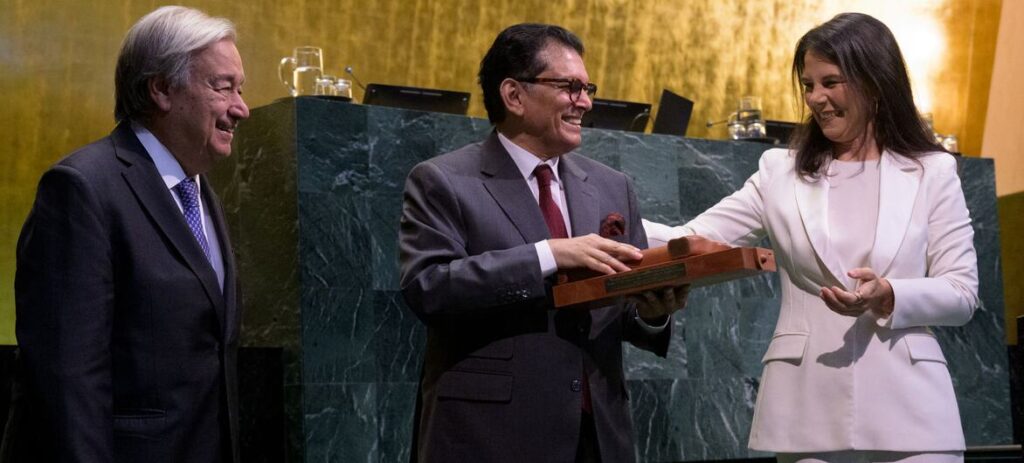
News24USA.Com Desk, New York — The United Nations opened its 81st General Assembly session Tuesday under mounting pressure to prove that global cooperation still works, as Bangladesh’s Khalilur Rahman took the presidency with a blunt warning: “This is not 1945. This is the 81st session.”
Rahman, a veteran Bangladeshi diplomat and former foreign minister, formally assumed the presidency at UN Headquarters in New York, pledging to help reshape an institution struggling to respond to wars, humanitarian emergencies, geopolitical rivalries, climate change and a growing deficit of public trust.
Receiving the symbolic Icelandic wooden gavel from outgoing General Assembly President Annalena Baerbock, Rahman declared that the United Nations must adapt to a world that has changed dramatically since the organization was founded.
“We must make the United Nations fit for the future,” he said, emphasizing the need to hear voices beyond governments, including civil society.
“We have a situation where trust is in deficit. This is not 1945. This is the 81st session. The world has moved on. The Organization must move on, and I’ll help that process,” Rahman said.
His presidency will center on the theme “Restoring trust, managing transformation: A United Nations that delivers for all.”
Rahman identified six priorities for the year: ending conflicts and strengthening peace, security and justice; accelerating progress toward the Sustainable Development Goals; confronting climate change and environmental degradation; protecting human rights and vulnerable populations; promoting inclusive digital governance and responsible development of artificial intelligence; and advancing UN reform and more inclusive global governance.
The new General Assembly leadership comes as the international system faces some of its most serious challenges in decades.
UN Secretary-General António Guterres, addressing the opening session, said the world is confronting armed conflicts, deep geopolitical divisions, the threat of nuclear escalation, persistent poverty and inequality, and increasingly severe climate-related disruptions.
“Rebuilding trust in the multilateral system is the defining challenge of our time,” Guterres said. “In these tumultuous times, the global problem-solving system is more crucial than ever.”
But Guterres acknowledged that the institutions designed to manage global crises are themselves under strain. From the UN Security Council to international financial institutions, multilateral bodies are struggling to deliver effective solutions amid growing geopolitical mistrust.
“International law and human rights — the core of our Organization — are too often flouted with impunity,” Guterres said, warning that suspicion among major powers continues to obstruct international cooperation and erode public confidence in the UN.
Despite those challenges, the secretary-general said he remained hopeful that diplomacy and dialogue could restore confidence in multilateralism.
Opening the General Assembly session for the final time as secretary-general, Guterres said he had “enormous hope” because of the work carried out at the United Nations.
“Through diplomacy, dialogue and collaboration, this Assembly can rebuild the trust and good faith that is missing from our geopolitics today and ensure the people of the world inherit a better, healthier and more peaceful future,” he said.
The Assembly’s previous president, Annalena Baerbock, also defended the organization’s relevance as she concluded her year in office.
“I am convinced more than ever of the importance and necessity of our United Nations,” Baerbock told ambassadors.
Responding to critics who argue that the UN has become ineffective or outdated, she challenged member states to consider the consequences of a world without the organization.
“In spite of its shortcomings, not a single day, not a single country, would be better off without the UN,” she said.
Baerbock pointed to UN humanitarian and peacekeeping operations, including the work of UNICEF and peacekeepers deployed in conflict-affected regions, as evidence of the organization’s continuing impact.
She also warned that positive stories about the UN often struggle to compete in an information environment where outrage and hatred attract greater attention.
“Our challenge though is that in a world where hate gets six times more clicks, these positive examples can easily go unnoticed,” she said.
A Critical Year Ahead
Rahman’s presidency will unfold against another major transition: the selection of the next UN secretary-general, whose term is scheduled to begin in January 2027.
Rahman previously served as Bangladesh’s National Security Adviser and High Representative for the Rohingya Issue in the country’s Interim Government. He has also held senior UN positions and was a founding member of East West University in Dhaka.
With the 81st session now underway, the central test for the General Assembly will be whether its calls for renewed trust can translate into concrete action on war, development, climate change, humanitarian crises, technology and UN reform.
For Rahman, the challenge is clear: lead an institution created for the world of 1945 into a global order that, as he put it, “has moved on.” UN Photo/Manuel Elías

সম্পর্কিত খবর

- যুক্তরাষ্ট্রপ্রবাসীর ছেলে সাগরের মৃত্যু: ‘হানি ট্র্যাপে’ হত্যার অভিযোগ, তদন্ত পিবিআইতে দেওয়ার দাবি, নিরপেক্ষ তদন্তের আহ্বান
- নিউইয়র্কে আদালতের নিষেধাজ্ঞায় বাংলাদেশ সোসাইটির নির্বাচন স্থগিত, ৫ নভেম্বর পরবর্তী শুনানি; সংবাদ সম্মেলনে আইনি পরিস্থিতি ব্যাখ্যা নির্বাচন কমিশনের
- চরমোনাই পীর সৈয়দ রেজাউল করীমের যুক্তরাষ্ট্র সফর উপলক্ষে নিউইয়র্কে দোয়া মাহফিল
- ওয়ার্ল্ড হিউম্যান রাইটস ডেভেলপমেন্ট ইউএসএর সাধারণ সম্পাদক ড. সাদিয়া
- New York Attorney General James Secures Reimbursements for T-Mobile Customers Whose Rates Were Unjustly Raised
- ফিলিস্তিনিদের আত্মনিয়ন্ত্রণের অধিকারের প্রতি বাংলাদেশের পূর্ণ সমর্থন: নিউইয়র্কে জাতিসংঘে রাষ্ট্রদূত আইরিন খান
- নিউইয়র্কে বাংলাদেশ সোসাইটির নির্বাচনে কুনু-ফিরোজ পরিষদের ইশতেহার ঘোষণা কমিউনিটি সেন্টার প্রতিষ্ঠা, সাশ্রয়ী ফিউনারেল সেবা, বিমানের সরাসরি ফ্লাইট ও আর্থিক স্বচ্ছতায় অঙ্গীকার
- New York Attorney General James Warns New Yorkers About AI-Generated Election Misinformation Ahead of November Elections