The Horizon of the AI Era: Reflections on Higher Education and Careers in the Age of Artificial Intelligence
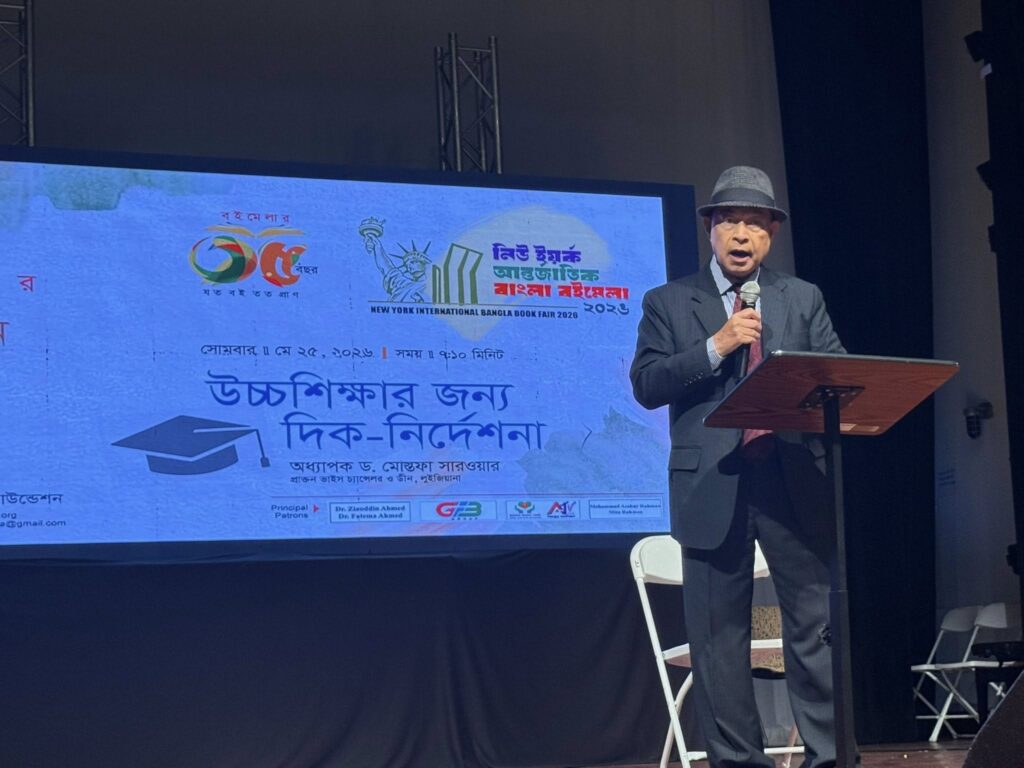
Dr. Mostofa Sarwar : Good morning, esteemed parents, colleagues, and most importantly, the visionary young minds who are the architects of our tomorrow.
In my years as a Professor of Geophysics, I learned to study the massive, unseen forces that reshape the physical Earth. But later, when I stepped into academic leadership as Vice Chancellor for Academic Affairs and Provost, my focus shifted to a different kind of disruption: the massive forces reshaping human society. As a Provost, my job was to look at the global horizon and ask, “What will the world look like when our current students graduate, and are we truly preparing them for it?”
Today, we stand on the precipice of a profound technological shift. It is a rapid, tectonic upheaval driven by the explosion of Artificial Intelligence.
For decades, higher education operated on a predictable formula: pick a major, memorize a specialized body of knowledge, master a discrete set of technical skills, and step into a stable career track.
Today, as a Professor Emeritus and former Provost, I am here to tell you plainly: that formula is obsolete. AI can write code, analyze legal contracts, diagnose illnesses, and generate creative content in seconds.
This is not a reason to despair, but it is an urgent call to adapt. Today, I want to share how our youth can build an “AI-proof” career, and how parents can guide them through a job market being rewritten in real-time.
My young friends, you are the first generation entering a workforce where you will actively compete—and collaborate—with cognitive automation.
If your educational strategy is simply to be a human database, memorizing facts to pass an exam, you are preparing to compete with an entity that has the entire sum of human knowledge at its fingertips. You cannot out-memorize AI.
Therefore, you must learn to out-human it.
Your value in the future job market will not be determined by what you know, but by how you think, create, and connect. To build a resilient professional foundation, focus on three things:
Master “Human-Only” Skills: AI is spectacular at pattern recognition and optimization. It is terrible at empathy, contextual judgment, ethical reasoning, and complex leadership. The most secure jobs of the future will marry technical literacy with these deep human soft skills.
Become an AI-Augmented Professional: Do not view AI as an enemy to avoid, nor as a crutch to make you lazy. View it as an exoskeleton for your mind. The future workforce will be divided between professionals who use AI and professionals who do not. Use these tools to automate mundane tasks so you can spend your time on high-level strategy and innovation.
Pivot to a “Fluid” Career Model: The concept of a single, lifelong profession is dissolving. To survive, you must fall in love with continuous learning. Your degree is not the end of your education; it is simply the license that proves you know how to learn.
Let us look at the actual terrain of future employment. As a former Provost who worked closely with corporate advisory boards, I want to demystify where the market is moving. We are seeing a massive shift away from routine cognitive tasks toward high-adaptability, multi-disciplinary professions.
If you are mapping out your future, look toward industries that sit at the intersection of technological advancement and human necessity:
The Bridge Builders (Tech Management): We don’t just need people who build AI models; we desperately need project managers and product designers who can translate what AI does into safe, profitable, and human-friendly business solutions.
The Green Economy: Climate change and resource management require massive human ingenuity. Renewable energy engineering, sustainable urban planning, and environmental data analysis require physical reality checks that AI cannot replicate on its own.
The Human Care Economy: Professions deeply rooted in human connection—advanced healthcare, mental health, occupational therapy, and specialized education—are growing rapidly. We crave human touch and empathy; a machine cannot comfort a patient or inspire a struggling student.
Now, to the parents in the room.
I understand the profound anxiety you feel. You see headlines about automation, and your natural instinct is to push your children toward what used to be safe havens. But pushing your child into a rigid, traditional mold out of fear is the most dangerous thing you can do right now. If you force them into a career path purely for “stability,” you may be training them for a job that a software update will eliminate in five years.
Instead of trying to be the architects of their specific career paths, become the anchors of their resilience. Trust their capacity to navigate a non-linear path.
I say this not just as a former Provost, but from my own kitchen table. My spouse, Dr. Syeda Sarwar, MD, and I had to apply this exact philosophy with our three children, all of whom took vastly different, diverse paths.
Our eldest son went to Harvard to study creative writing—a discipline focused entirely on narrative and the human condition. He didn’t follow a rigid corporate path, but his deep understanding of language and logic eventually led him into law. He became a highly successful intellectual property attorney, and served as the lead litigation attorney in a case supporting Google—and won it.
Our second son also went to Harvard, but his brain operated in a completely different domain: he majored in pure mathematics. Today, he successfully applies those abstract analytical frameworks in the high-stakes, fast-paced world of a hedge fund.
And our daughter chose a different path entirely. She went to Tulane to study psychology, mastering the understanding of human behavior, and used that foundation to pivot into medicine, earning her PharmD.
Three children. Three completely distinct disciplines—the humanities, the hard sciences, and the social sciences. Yet each of them found immense professional success because they weren’t forced into a singular, traditional mold. They were allowed to build their own unique foundational strengths and adapt them to a shifting world.
Stop measuring the value of your child’s education by how traditional or recognizable their major sounds. Encourage them to take interdisciplinary courses. If your child wants to study philosophy or literature alongside data science, encourage them. That combination creates an individual who understands both how the machine works and why humanity needs it. That is the exact profile global employers are desperately seeking.
As I stand before you today, having spent a lifetime looking at both the history of our planet and the cutting edge of our universities, I am profoundly optimistic.
AI is a tool of unprecedented power. It will automate the routine, the repetitive, and the mundane. But what it leaves behind is truly human. By taking over the mechanical tasks of thinking, AI is actually challenging us to be more creative, more ethical, and more compassionate.
To the young generation: Do not look at the future with fear. Look at AI as a canvas, and yourselves as the artists. Use these tools to solve the grand challenges of your time—from curing diseases to stabilizing our planet’s climate. The future does not belong to the machines; it belongs to the humans who know how to command them.
To the parents: Thank you for your sacrifices. The best gift you can give your children today is not a mapped-out, predictable life, but a deep confidence in their own ability to learn, adapt, and stand tall amidst change.
Let us walk into this new frontier together, with open minds, fierce curiosity, and absolute confidence in human potential.
[Speech delivered by Professor Emeritus and former Vice-Chancellor Dr. Mostofa Sarwar as a guest speaker at the 35th New York International Bangla Book Fair, Jamaica Performing Arts Center, May 25, 2026]

- নিউইয়র্কের ওজনপার্কে খলিল বিরিয়ানির নতুন শাখা: দেশীয় খাবারের চাহিদা বিবেচনায় নতুন উদ্যোগ, মান ও সেবায় গুরুত্ব
- BOROUGH PRESIDENT GIBSON CELEBRATES BRONX COMMUNITY DISTRICTS AMONG NYC`S LEADING CONTRIBUTORS TO HOUSING DEVELOPMENT
- New York Attorney General James Challenges Federal Rollback of Fuel Economy Standards
- নিউইয়র্কের জ্যামাইকায় বাংলা স্কুলের তৃতীয় শাখা চালু; বিভিন্ন এলাকায় আরও শাখা খোলার পরিকল্পনা বাংলাদেশ সোসাইটির
- নিউইয়র্কে মুসলিম ডে প্যারেড অনুষ্ঠিত
- আমেরিকা-বাংলাদেশ প্রেসক্লাবের ১৮ বছর পূর্তিতে সেমিনার: ‘রাজনৈতিক তোষামোদে গণমাধ্যমের গ্রহণযোগ্যতা কমে’
- নিউইয়র্কে বাংলাদেশ সোসাইটির আর্থিক হিসাব ও অভিযোগ নিয়ে সংবাদ সম্মেলন: ৯ লাখ ১৯ হাজার ডলার গচ্ছিত থাকার দাবি, ৭ লাখ ২৫ হাজার ডলার ব্যয়ের অভিযোগ নাকচ
- নিউইয়র্কে বাংলাদেশ কনস্যুলেটে ফি পরিশোধে নতুন নিয়ম: স্বশরীরে সেবায় মানি অর্ডার-চেক ও নগদ বন্ধ, শুধু ডেবিট-ক্রেডিট কার্ড